
The Investor
For ten years, Jean de La Rochebrochard has invested Xavier Niel’s money in more than a thousand startups. What drives him?

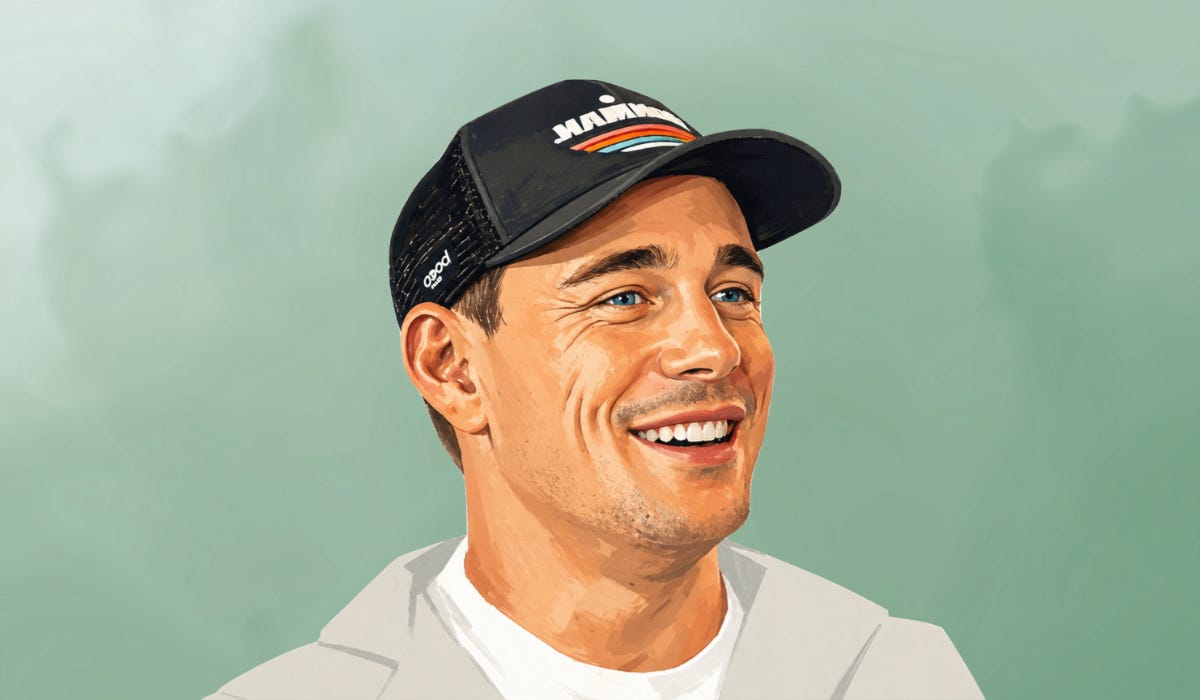
A television screen stands behind Jean de La Rochebrochard. It is 11 a.m., and it reads Participant 24/100—01:32. The thermometer in the vast Halle de La Machine, in Toulouse, registers 35 degrees. Jean is dressed accordingly. He wears a white V-neck t-shirt that reveals a tan line at the bottom of the biceps, navy chino shorts that show his shaved legs, and a pair of cream suede loafers. His IronMan cap is set aside, but the Garmin stays on his left wrist. Standing, then sitting, then standing again, he listens carefully to the hundred entrepreneurs who have come from France, Belgium, and Spain to pitch him their projects.
A few days earlier, he had read a comment online: “Why are you wasting time pitching to Jean? You should be talking to your customers.” So Jean does not want to disappoint the founders who made the trip. A bottle of water, coffee, and two cans of Red Bull fuel him—the night before, he had switched hotels late in the evening because the air conditioning was broken.
For ten hours, Jean moves from healthcare to defense, education to hardware, music to nutrition. He listens more than he speaks, but his feedback is sharp. It catches founders off guard, makes them think, sometimes alters a trajectory. It is 7 p.m. when the marathon ends. His partner hands him a box of DeVilmar cookies. The first bite, in the now-empty hall, brings him back to life.
The following Monday afternoon, Jean is back behind his screen, camera on. From two to six, from his house in the south of France, he runs through twelve twenty-minute meetings with founders. He does the same the next afternoon, and repeats the pattern every week. By the end of each meeting, his decision is made. Either he invests, or he passes. Within twenty-four hours, he sends an email with a final answer. Sometimes a term sheet.
Like the day Jean is in Barcelona and gets a message from Antoine Martin, the co-founder of Zenly and Amo: “You have to meet the team at Sourced, their model is really interesting.” Jean writes that same day and meets the CEO Eiso Kant, who has come up from Madrid. That night, he sends him a term sheet. “Look how crazy a VC sending a term sheet over Whatsapp,” Eiso Kant texts his co-founder.
*
One evening in 2010, Jean shares a beer with Pascal Mercier, a fundraising adviser well known in the Paris scene. They had met by accident on Twitter, when Jean had forgotten to mention him in a retweet. Mercier had pointed it out. “I felt like a bit of an idiot,” Jean recalls, before editing his tweet. “Come tell me about your fundraises sometime,” Mercier slipped him in a private message.
“I want the number one to hire me, and the number one is you,” Jean says at that first meeting. He knows it is a one-shot opportunity and he does not want to miss it.
In school, Jean spent each day waiting for the next one. He repeated the year in seconde, repeated again at university, and landed in a master’s in International Strategic Management at the Sorbonne after being turned down by the finance programs he had aimed for. Alongside his studies, he ran AdWords campaigns and built websites for his father’s restaurant-owner friends. After sending out a hundred emails with the same cover letter and the same CV, he found an internship at a consulting firm in the middle of the subprime crisis. He stayed a year and a half, worked on fundraises, then went out on his own with a former colleague for two years.
“I only work with you if there’s a fit,” Mercier replies. “And to see if there’s a fit, we need to grab a few beers over the next few months.”
After four meetings and another beer with the team, Jean joins. “I didn’t hire Jean. Jean picked me as his boss,” Mercier laughs.
One afternoon, as Jean walks him through a deck, Mercier interrupts him several times.
“Yes, I know,” Jean keeps saying.
“No—and when you don’t know, say so,” Mercier tells him before continuing. “You think it makes you smaller, but it doesn’t. It shows that you’re powerful. That you can afford it. Only the chef says ‘I don’t know.’ The sous-chef says ‘I know, I know, I know.’ You’ll see, when you say you don’t know, people will say ‘wow.’ And they’ll be thrilled to explain.” Years later, Jean still tells this story on the podcasts he goes on.
He thrives in this small team of four, and discovers he is good at selling. Sometimes, before meetings, he slips into a corner of the room to read and concentrate, alone in the silence. Other times, Pascal Mercier has to calm him down, when he starts scribbling a flurry of ideas on a scrap of paper in front of clients, full of energy.
During this period, Jean grows closer to the entrepreneurs. One early morning in 2013, at six o’clock, Alert Us—Antoine Martin’s first project, a geolocation app for teenagers’ safety—launches with great fanfare on Vente Privée. That day, the team is flooded with emails and, among the first, a mysterious message.
“Nice work guys, this is killer — Jean 2LR.”
Then, fifteen minutes later, a second email lands in the thread.
“That said, there’s a lot of work to do on the UX.”
The next day, once the storm has passed and after some quick research on what UX means, Antoine Martin takes the time to write back to this stranger.
“Thanks for the feedback, what do you mean?”
“I’m five minutes away, I’ll come grab a coffee in fifteen,” Jean replies.
Fifteen minutes later, he taps on the ground-floor office window. He sits down, takes a few sips of his coffee, and rolls through his feedback. For a year, he drops by unannounced every month to help the team.
The closer Jean gets to the entrepreneurs, the more distant he becomes from investors. He resents the way they invest, the way they behave. For some time now he has wanted to invest himself, and he has clear ideas about how to do it. He wants to make a lot of deals, take a lot of risks, invest the American way. He applies to venture funds, but no one hires him. A fundraising adviser turned investor, that is not how it works.
One day, he meets Martin Mignot, an investor at Index Ventures, who introduces him to an unusual crew: Nicolas Colin, Alice Zagury, and Oussama Ammar. The three had launched The Family six months earlier, and from those first conversations with the team Jean picks up a unique energy. Since the investors don’t want him, he will go to a place where he can build a fund of his own, or at least move up a level.
“I can pay you now, but in three months, I don’t know. I’d rather you knew that,” Oussama Ammar warns him. Jean has just turned thirty, has little money set aside, and is now expecting his third child over three and a half years. He resigns two weeks later, without telling his wife how uncertain the situation is.
*
Jean stands still in front of a hundred entrepreneurs. Two palm trees, brushing the glass roof above him, rise on either side. Oriental rugs cover the floor, a small wooden table sits to his left, his MacBook on it. He has not yet shed his investment-banker habits and wears a shirt and a blazer. Slides scroll across the four screens behind him that read as one; he is giving a workshop on fundraising.
Jean helps the startups in the accelerator with fundraising and sales. With Pascal Mercier, he had learned to sell. At The Family, he learns to speak on stage, and he begins to write. In speech and on the page, he does not soften his words. His vocabulary cuts, so do his positions. “Sometimes you don’t communicate well. The world isn’t black or white,” Pascal Mercier warns him, still watching over him.
The more investors Jean meets, the more his frustration grows. He finds that they don’t reply to emails, that they show up late. “I want to show them what investing is. I want to crush them. I want to be number one,” he tells himself. He resented investors for being arrogant in private; he was going to be arrogant in public.
He runs into that same lack of responsiveness and interest when he goes out fundraising with Captain Train. It is what pushes him to send an email to Xavier Niel, whom he has never met, to suggest he invest. Niel accepts the meeting with the CEO, a meeting Jean decides not to attend.
He keeps a low profile in the months that follow, but does not let Niel forget him. Every so often he sends him deals—after Captain Train, Niel also invests in Wedoogift, another startup Jean brings to him.
“Hey, when are you coming to see me?” Niel writes him a few weeks later.
In March 2015, Jean walks past the columns at the entrance of Iliad headquarters, the parent company of Free, in the eighth arrondissement of Paris. He takes the lift to the eighth floor and settles on a grey couch in a meeting room. Jean has taken the afternoon off. He does not know how long this will last, or why he is there. He hopes, without admitting it to himself, that it is about Kima. He has one question, and he is saving it for the end.
Niel walks in. He is not in his usual white shirt but in a t-shirt, jeans, and sneakers. He is unshaven, it is a week off. The conversation runs for two hours. Jean and Niel talk about The Family, about investing, about Captain Train. Niel asks a lot of questions.
“One of the things he does really well, like every great entrepreneur, is ask a lot of questions. These are people who are good at their decisions because they ask an enormous number of questions. They take in a quantity of information per minute that has nothing to do with anyone else, and they build up a form of strategic discernment that’s exceptional, that others don’t have,” Jean says.
At the end of the two hours, it is his turn to ask his. He knows that Jérémie Berrebi, who runs the venture capital arm of his family office, is on his way out.
“And, by the way, Kima? How is it going now that Jérémie is leaving?” he asks.
“Oh you know, Kima, there are still the two analysts, it’s running,” Niel answers.
A memory comes back to Jean. His meeting with Jérémie Berrebi a few years earlier, when he had thought to himself, “That guy has my dream job, a job I will never have.”
*
Two weeks after that meeting, Jean’s phone rings. The head of Niel’s holding company is on the line. “Jean, we know you’re very happy at The Family, but Xavier wanted to know whether you’d be interested in joining Kima?” Jean accepts, but does not forget to set his terms. Six months of negotiations follow over compensation. Jean waits it out and refuses to ask Niel to step in to speed up his arrival. “If he hires me, it’s not so I can be a pain,” he tells himself.
When Alert Us becomes Zenly in 2015 and goes out fundraising, Jean is not yet officially at Kima. The founders decide to spend a few days in London, where venture investors are more active. An hour before departure, Jean announces he is coming along.
After two hours and fifteen minutes, the Eurostar pulls into St Pancras. It is morning. The two founders have only one meeting on the books for the next forty-eight hours. Once they reach the apartment a friend of Martin’s has lent them, Jean settles in his corner, opens his laptop, and sends twenty emails to London investors in his network. Each one starts the same way: “I know you won’t do it, but for your information…” He unlocks about ten meetings that way, but the partners they meet would rather invest smaller tickets, directly, since Zenly is not yet generating revenue. Kima, which usually invests €150,000, is going to have to lead the round—a few million.
Several emails are exchanged with Niel that summer.
“I don’t know what you usually do. To co-lead the round, you would need to meet them first,” Jean writes.
The next day, Niel writes back.
“But you’ve met them, and you’re saying it’s a future hit?”
Then, two hours later: “I trust you :)”
In September 2015, Jean moves into an office on the second floor, a few floors below Xavier Niel. He has no job description, no roadmap. Months pass and the two have still not seen each other again. A mix of trust and distance settles between them, which is uncomfortable for Jean. But however rarely they meet, Xavier Niel is always available and answers his emails at lightning speed. How does he do it? Jean wonders. Since arriving at Kima, he has let his calendar overrun him. Two investments a week takes organization.
A few weeks after Jean’s arrival, Alexis Robert is the one waiting at Iliad. He had already met the other members of the team, and Jean was the last person he was meant to meet. Robert had spent a long time wondering how to dress for the meeting. Suit or casual? He had finally settled on a navy t-shirt. When he saw Jean coming toward him in the distance, he wondered if he had made a mistake. Jean is in a suit—the only time Robert will ever see him dressed that way.
Alexis Robert has been a coder since he was a child, and joins Kima after several entrepreneurial ventures. He is applying for a mission that is unusual for a venture firm at the time: build the firm’s tech and automate its processes. But his role quickly outgrows, and by far, what it was at the start.
Jean and Alexis Robert are yin and yang. One fouls things up, the other cleans them up. Jean is the public face of Kima—the external CEO. He goes on podcasts and tends to his content. Alexis Robert is the hidden face of Kima—the internal CEO. He creates the reports for Niel’s holding company and runs the team. That balance is what Kima rests on today.
Jean is a solo flyer. He is at ease in small teams and likes to execute on his own. Interactions cost him energy. This lean model, “in Xavier Niel’s image,” is what he loves about Kima. Everyone is autonomous, and that is a condition for joining the team. “I’m a poor manager.” Jean does not take his employees by the hand, does not give feedback, does not run team meetings or one-to-ones. Everyone works from home. He moves between Paris, New York, and the south of France, and the work is mostly asynchronous. There have been stretches where Jean and Alexis Robert did not see each other for months. Just as Xavier Niel did with him in his early days, Jean sets up with his employees a mix of trust and distance that can throw people off.
When people criticize Kima’s model—investing in a very large number of startups—Jean takes a wicked pleasure in answering: “We’re everywhere, but we’re in every good deal.”
Two investments a week do not allow Jean to be proactive with the entrepreneurs he backs, but he always makes himself available.
Sometimes in the spur of the moment. Like when Alexandre Louisy, the co-founder and CEO of Upflow, in which Kima invested, is at his New York office. “Alex, I’m downstairs, come grab lunch,” Jean writes. Lunch lasts twenty minutes, over a sandwich or a salad.
As with his employees, Jean does not coddle his entrepreneurs, does not take them by the hand, and gives them his time only when they need it. His goal is to optimize the ratio between the time he gives and the impact he has. That comes from clear-sightedness, followed by frank, direct conversations. With more than a thousand startups in Kima’s portfolio, he has seen every problem there is, which gives him an unusual capacity for discernment. He does not expect entrepreneurs to take all of his recommendations at face value, but he watches what they do with them. If they do not react, he moves on.
“Entrepreneurs—who they are, what they become, what keeps them up at night—it moves me, it feeds me, it makes me want to be in the trenches with them. I’m good when things are going badly. I’m not good when everything is fine. I’m not the kind to send confetti,” he explains.
One summer day in 2016, Jean is at the wheel of a Jeep heading for Coachella. He is with Michael Goldenstein, a young hire running growth at Zenly in the United States. In the trunk, several bags hold three thousand PopSockets stamped with the startup’s logo, which Jean had ordered a few days earlier on Alibaba. A party is being thrown at a house rented by the young influencer Jake Paul, with whom Zenly has struck a partnership. This is a few weeks before the acquisition of the French startup by Snap closes, and the two founders are stuck in Paris. Jean steps in for them at the last minute, takes Goldenstein along to spend several days at the festival sticking the accessories onto influencers’ phones. Forty-five days later, Snap acquires Zenly for over 300 million dollars.
These flashes, these last-minute trips alongside the entrepreneurs, Jean loves them. He feels alive. Useful.
*
A few months later, he is sitting at his computer screen. He does not move from it all day, he has broken his foot playing squash. Unable to do much else, he decides to put his immobility to use. He had given a workshop at The Family on productivity, which he had called Human Machine, but he had never managed to articulate his thinking properly. Writing a book might let him do it. He decides to dedicate two hours a day to writing, but nothing comes out. His own nature, that of a disorganized person, resists him. If he writes, it is also to learn.
Back on his feet, he decides to isolate himself for four weeks in an Airbnb in Los Angeles to finish the book. Every day, he wakes up at five in the morning, works through his emails until eight, writes until two, takes meetings until six, then ends his day going through his emails again. By the end of his stay in California, the book is done. On the back cover, he writes: “Always strive to become the best version of yourself.”
“Getting him to fill in a CRM is always a struggle,” Alexis Robert laughs.
Jean gets 200 emails a day—about twenty pitches, ten updates from the entrepreneurs in his portfolio, ten documents to sign online, and portfolio management.
He looks at all of them. His job is to pick out the weak signals, which is what technology cannot do. Reading a pitch takes him between one and four minutes. Investing in a startup that fails is part of the job. Not investing in a startup that succeeds is annoying. But what he does not want is to lack the access to invest, to lack the choice of saying no.
Only then does he reach for, eight times out of ten, the shortcut he uses the most on Superhuman, the app he uses to manage his email: ;. “No deal FR” or “No deal EN” opens up, and the message appears: “Hi, thanks for your email, unfortunately that won’t be an opportunity for us, sorry.”
Niel is known for answering all his emails quickly. Jean adopts the same rule and builds systems to make sure he never breaks it.
*
One summer in 2021, Jean is waiting in a private jet on the tarmac at San Francisco airport. He is early. A message comes up on his phone. It is Xavier Niel.
“Heading to In&Out
You want something?”
“A double double :) thanks,” Jean answers.
“Protein style or the real one?
With or without onions?
Anything else?”
Thirty minutes later, Niel hands Jean a hot burger.
“Cool, it’s still warm!” Jean thanks him.
“It is still warm because Xavier waited to finish his burger before lining up to get yours,” the person with Niel whispers to him.
Jean keeps the moment and files it away with the others. There is one he has been repeating to himself ever since he started spending time around the French billionaire: the more power you have, the kinder and more generous you must be.
Jean’s job is to bring serenity to Niel—by making deals, by performing, by being there for the entrepreneurs. He is Niel’s proxy with them. When entrepreneurs call him, they should feel as if they are talking to Niel. And when Niel tells them something, Jean had better have told them the same thing.
“I tell myself regularly that I’m not good enough. Not for him, not for the entrepreneurs, not for my fiancée, not for my children. My neurosis is not being good enough. With Xavier, I ask myself that question every day.”
For Jean, there are three qualities that matter for working with Niel: honesty, likability, and efficiency—on top of performing. Jean cultivates them every day and makes sure he is ready to answer the message he will receive after the next big funding round of a startup: “Did we invest in this startup at the seed round?”
*
In January 2024, Jean and Pia d’Iribarne are coming out of a lunch with an entrepreneur, and the first New Wave fund—on which they have both been Partners for three years, and on which Xavier Niel and Antoine Martin are founders and LPs—is a success. Mistral AI, Poolside, and BeReal are among the early investments. A second hundred-million-euro fund is about to close, but something on the way out of the restaurant brings Jean back to the same realization. He can no longer work with his partner. He has known for six months, but says nothing. Each new frustration, he closes up. Until that moment, a few days after the lunch, when Jean tells d’Iribarne he is not joining her in the second fund. The amicable split he proposes is brushed aside. A few days later, he is fired.
The press picks up the story. Rumors circulate about New Wave, about him, about his personal life. His reputation takes a hit, but Jean does not react. “It’s a major mistake. At the time, I don’t understand it. It’s not the Jean I know,” Antoine Martin says. “His way of resolving the conflict was to give everything up.”
Niel reads him the riot act: “You messed up. You’re doing this a month before closing the fund. I get it, but you could have handled it better. You should have split earlier and negotiated your shareholder agreement better.”
Jean takes it.
“I dragged my feet. I didn’t want to face the truth. I should have dealt with it faster, and been more combative. I don’t like to come with my problems, I like to come with solutions. I compensate, I stay quiet. It’s the fear of being rejected. The fear that the moment I show a weakness, the person across from me has less admiration for me. So you pretend to always be there, always up to it. When something is wrong, you don’t say so. You lock your emotions away. For a long time I did that, and breakups were brutal because people didn’t see them coming.”
“This crisis reconnected me to something important. I always talked to people about body and mind. You have to sleep well, eat well, exercise well. For the mind, always be in a dynamic of learning, of improvement, open to feedback. But I had completely neglected the importance of the soul, which is the only thing left when everything falls apart. I reconnected to that. And to the idea that the first thing to do, in your daily life, is to learn to let go, to forgive yourself, to love yourself, and do the same with others.”
*
A few months later, Jean breaks the surface. He is gasping. His Garmin reads 160 bpm and he can hear his heart pounding in his ears. He is eight minutes behind on the 1:14 swim he had planned with his coach. He had aimed for 1:50/100m but his watch shows an average of 2:03. He runs toward the transition zone, pulling off his goggles and his swim cap, yanking the cord that unzips his black neoprene wetsuit. He had rehearsed the move many times. He is now in a red trisuit with Jean de La Rochebrochard printed on the back, above an angular flat design representing a tiger, a horse, and a dragon—the three Chinese signs of his children—designed as a heart. He puts on his visored helmet, pulls on his black compression socks, climbs onto his Canyon Speedmax—also red—and sets off for 180 km on the roads above Nice.
He checks his bike computer often. First climb, 270 watts, under control. Second climb, 260 watts, something is off. He had planned to be at 158 bpm but he is stuck at 153 with twenty watts less. Dark thoughts settle in. He plays back, on a loop, a scene from an episode of the Netflix series Tour de France: “Pain is temporary. Quitting lasts forever.” When he unclips from his bike, his watch reads 5:30 for the second leg. He laces up his white Nike Alphaflys for the 42 km run, planning to hold a pace of 4:45/km. When he crosses the finish line, 10 hours, 23 minutes and 15 seconds after the start, his body has taken control over his thoughts. He raises his fists, closes his eyes, and stops the run on his Garmin.
Jean had never done much sport before this. He had tried squash and climbing, but had quickly given up. A friend who had just moved to Aix-en-Provence had convinced him in 2021 to join his cycling group. In 2023, he raced his first half-ironman and finished it not without difficulty—he realized he could not really swim freestyle, and finished the swim in breaststroke—six minutes behind the planned 5:30. But he is hooked. He finds himself in the effort and the resilience the sport demands. “I grind people down.”
He also loves the data that pours out of every gadget he buys to keep improving: speed, power, heart rate, cadence, elevation. It reminds him of the Google Sheets of the entrepreneurs he watches go by at Kima.
One day, he shows up at Zenly’s offices and spends four hours diving into the startup’s numbers. He opens a Google Sheet, drops in stacks of raw data, and turns it into a story: organic reality, retention, the comparison to the market.
For three years, Jean spends his time on the road, on the shoulder of the road, or in a pool. Chronic tiredness has become normal. His calendar revolves around his sessions, and doing everything at once becomes hard. He sets the Ironmans aside and replaces them with fifteen minutes a day of high-intensity interval training and a few swim sessions whenever he can. A new project also takes up his time.
In 2025, he partners with Emmanuel Seugé, the founder of Cassius, to deploy the American VC’s third fund, which invests at the intersection of consumer and tech, in repeat European founders looking to take on the American market. Jean has known Seugé since 2017. They had crossed paths on deals, co-invested, ended up in the same scrapes. Emmanuel is based in Atlanta and, like Jean, he prefers the trenches to the cocktails. “You see what people are really made of when things go to hell,” Jean says.
*
Spring 2026, he walks along the harbor in Bormes-les-Mimosas. The sky is clear and the sun is bright. The week is winding down, it is Friday at noon. One might think he is talking to himself, but he is not. He is dictating voice notes with Wispr Flow, which sends them automatically to Superhuman, where they come out written in his tone of voice. The emails go out one after the other: “I’m trying to be worthy of the boss.” Before heading home, he sits down and looks out at the Mediterranean stretched in front of him. He meditates, then he prays.
Notes:
Above all, thank you to Jean. We spent long hours on the phone these past weeks and, as you may have noticed in this profile, he confided, unfiltered. Also, thank you to Pascal Mercier and Antoine Martin for welcoming me into their offices, and to Alex Louisy and Alexis Robert for our discussions. A few podcasts helped me get a sense of Jean’s story too: GDIY, Makrs, Silicon Carne, and Little Big Things, whose visual I used for my illustration. Finally, Jean’s blog was a treasure trove of anecdotes and sharp thoughts.
These deeply reported profiles illustrate the work I do with founders, helping them build and tell their narrative. If you’d like to know more, here are three steps to start with.
If you enjoyed this piece, you can show your support by liking, commenting, and sharing. It helps me a lot to gain visibility on Substack and beyond.
Oh you brought back some sweet memories ! The Feedback Mashine was so intense and Jean was crazy courageous to accept our challenge.
Every single one of the 100 founders that met him that day were happy and executed like madmen the next days.
Small correction btw, it was not « Les Halles de La Machine », it was www.lamashine.com