
The Campus
Station F was born to showcase French tech. Now it wants to lead the world in AI. What will it take?

All eyes were fixed on the right side of the stage. Mobile phones were raised above the crowd. Some stood on tiptoe trying to make out a face, even just a silhouette of hair.
The taller ones could spot a small circle of four people deep in conversation. There was Xavier Niel, the billionaire entrepreneur behind Free and Station F; Roxanne Varza, the campus director; Clara Chappaz, then Minister Delegate for Artificial Intelligence; and the man everyone was waiting for: Sam Altman, co-founder and CEO of OpenAI, who was about to take the stage.
On February 11, 2025, Altman appeared at Business Day held at Station F as part of the AI Summit. He would occasionally slip into the transparent soundproof booths of the Share space to take calls from the United States. His former associate turned rival, Elon Musk, had just made a $100 billion offer to acquire OpenAI.
On stage, dressed in a charcoal suit, a matching polka-dot tie, and tan Oxford shoes, he wore the red French Tech rooster proudly on the lapel. Interviewed by Chappaz, he praised France at length: “The engineering talent, the entrepreneurial spirit, the belief in energy, which I expect will become super important as we continue in this AI journey. France has got a lot of advantages.”
As he stepped off stage, Altman exchanged a few words with the next speaker. It was Yann LeCun, former Chief AI Scientist at Meta and now founder of AMI Labs.
Earlier that day, French President Emmanuel Macron had taken the stage. A crowd gathered around him, as it does at each of his appearances on campus. Behind him stood the leading figures of the French tech scene: Arthur Mensch of Mistral AI, Eleonore Crespo of Pigment, Florian Douetteau of Dataiku, Clément Delangue of Hugging Face, and many more. “We have everything we need here to succeed in AI,” he declared.
That afternoon, the world was watching Paris, and Station F was its epicentre.
*
In 2014, a new message appeared in Varza’s inbox while she was on holiday in the United States, her home country. The director of Station F was born in Palo Alto, California—something that catches you off guard the first time you hear her speak since her French is that flawless.
The subject line was intriguing: “Are you having trouble with jet lag?” The sender was Xavier Niel, whom she had met a few years earlier when she was a journalist at TechCrunch. The French entrepreneur had been working on a project for two years and asked Varza whether she would be willing to benchmark the world’s most successful incubators for him. She agreed, not knowing where any of it would lead.
A year earlier, Niel had acquired the Halle Freyssinet, a historic railway building constructed in the 1920s near the Gare d’Austerlitz, in Paris’s 13th district. “I have this big building, I’m going to put 1,000 startups in it.” That, in its entirety, was his pitch to Varza.
Vague as the proposal was, Niel’s objective was clear: to put the French tech ecosystem on the map. As he put it at a conference in 2018, “we are often very good, but we are not good at image,” speaking of France. After a few meetings, Niel asked Varza to lead the project. “I want to do everything,” she replied.
Varza took the opposite path from most French and European startups. She arrived from California in 2005 for a university exchange in Bordeaux as part of her French literature degree, fell in love with France first, then with its tech ecosystem. Everything still had to be built. She started working for Business France, tasked with encouraging Silicon Valley companies to set up in France. She documented her adventures on the blog TechBaguette, chronicling “the adventures of a Silicon Valley native discovering the tech startup scene in Paris, France.” Her writing talent and deep knowledge of the French tech scene led her to become editor of TechCrunch France in 2010, before joining Microsoft’s incubator in the Sentier district of Paris in 2012.
Varza holds three passports: American, Iranian, and French since 2019. Beyond her experience in tech, which makes her the ideal profile to run a campus of this kind, she embodies the multiculturalism that Niel values and wanted to bring to Station F. More than 70 nationalities are represented on campus today, and from the start Varza established English as the primary language for communications.
In 2014, the first stone of the campus was laid by the then-president François Hollande. When Niel presented him with the project, the President replied “But are you certain there are 1,000 startups in France?” Niel had never asked himself the question, but it turned out there were, with 11,000 applications submitted in the first year.
Three years of construction work followed before the building came back to life, with a launch scheduled for April 2017. In the meantime, Varza visited Google Campus in London, The Factory in Berlin, and The Box in San Francisco, drawing inspiration and working out what kind of support Station F would offer its startups. It was during a conversation with the founder of Algolia that something clicked. “He did not like the idea of Station F,” she recounted in an interview with British media outlet Sifted. “He was like, ‘I’m never going to go there. And let me tell you why. My company is 60 people. I really want my brand, I don’t want to be competing with people around me for talent...’ He really broke it down for me, and that helped me understand the disadvantages of being in this kind of space and what kind of company would actually benefit.” The campus would therefore support early-stage startups with fewer than 15 employees.
After a three-month delay caused by a flood—the three basement levels were inundated due to a badly installed pipe, and since all the technical infrastructure was underground, the damage was severe—Station F launched in all its glory on June 29, 2017.
A white square stage was set up in the middle of the Share space, one of the three areas that make up the campus. Varza began her speech in front of the 2,000 people gathered around her. First in English, then in French, she worked the crowd. Niel, discreet but warmly applauded during the acknowledgments, watched his protégée from the front row alongside Jean-Michel Wilmotte, the architect behind the hall’s transformation. Anne Hidalgo spoke next, then President Macron, elected two months earlier. He closed his ten-minute speech by declaring, in English: “Entrepreneur is the new France.”
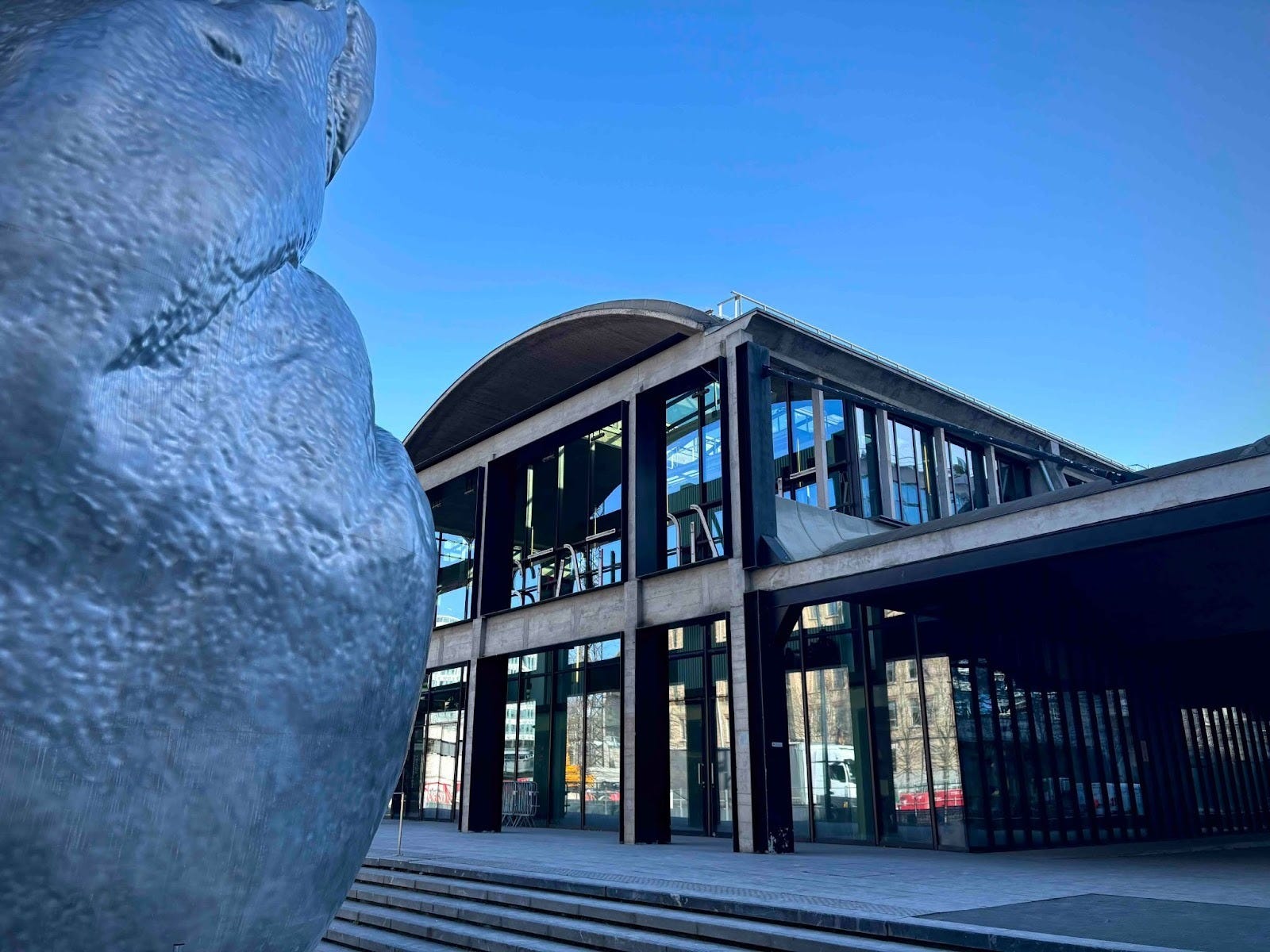
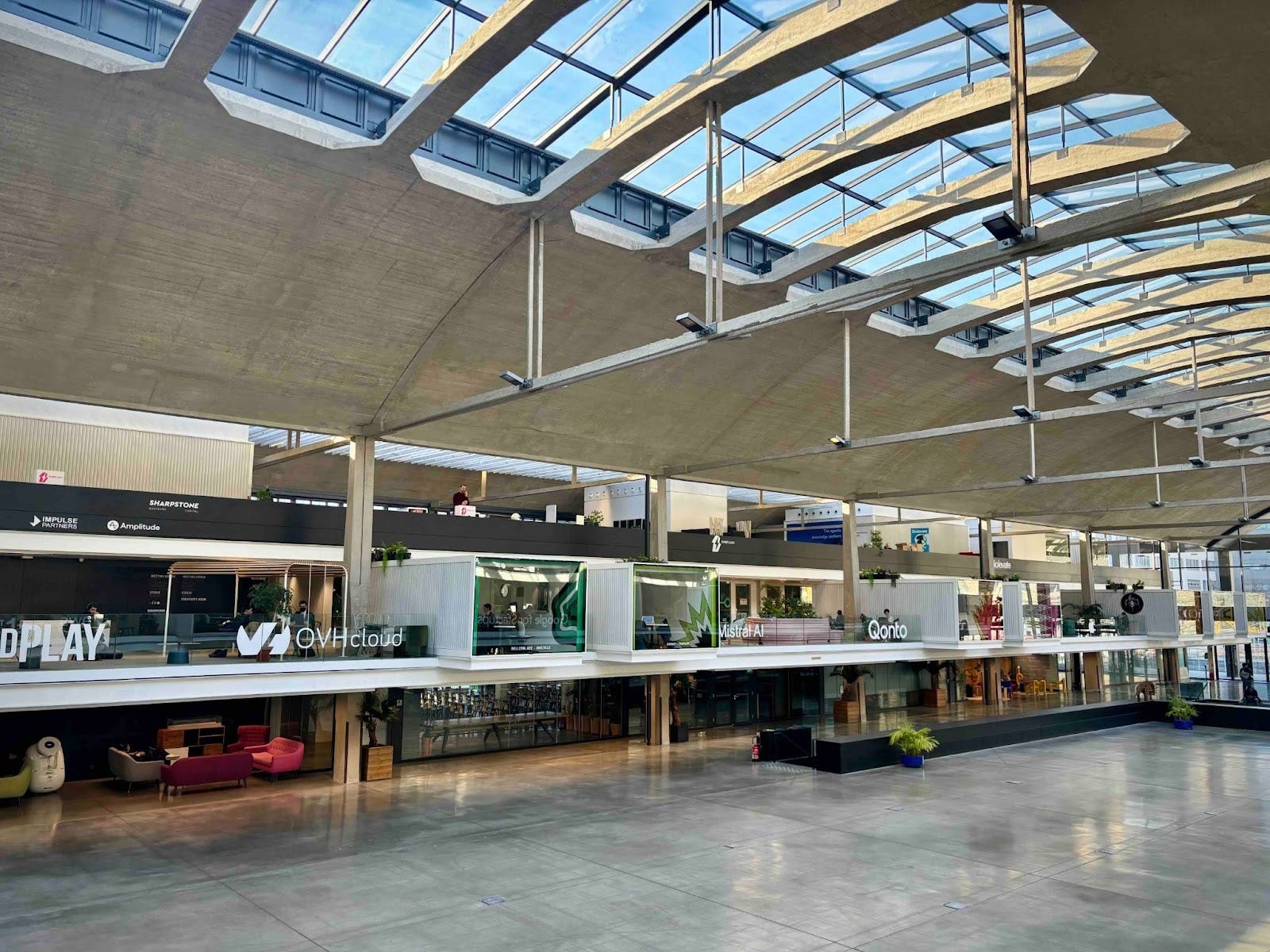
In normal times, the Share space is quiet. It is a vast two-storey hall whose scale you can’t grasp straight away. That is, until you look up. On either side, across the glass walls of both floors, logos accumulate: Mistral AI, OpenAI, Kima Ventures, Index Ventures, Lightspeed, La French Tech. Dozens of companies, investors, campus partners, each with their own small patch of territory. On some days, up to 2,000 people pack in for an event, and the artwork at the center—a multicolored mountain of modelling clay in aluminum, sculpted by Jeff Koons—disappears into the crowd. On other days, in absolute silence, an entrepreneur crosses the hall with purpose, MacBook under their arm, on their way to meet an investor. Sometimes a foreign delegation follows a guide, often Varza, heads tilted back. Here, you always look up.
On the other side of the Passage Louise, the atmosphere shifts. In the Create space, there is life. People standing, conversations, movement. Along the sides, it is no longer the logos of investors you see but those of the incubators: Microsoft, Meta, HEC, CentraleSupélec, LVMH, Binance, and many more. For nine years, the biggest names in global tech, the flagships of French industry, and the country’s leading schools have each run a programme here. Thirty in total, including three in-house, and 3,000 desks. This is where entrepreneurs spend their days, but not their whole lives. “The people who come to Station F, we want to keep them for six months and then have them go elsewhere,” Niel said a year after the campus launched.
Through a second passage, Anatole, accessible from either side, the Chill space, better known as La Felicità, reveals itself. It is a 4,500 square-meter food court created by restaurant group Big Mamma, open to the general public. A long queue regularly forms along the building on evenings and weekends. “I didn’t even know there was a startup space here,” you sometimes hear. Red oriental rugs cover the floor, and rail cars form a corridor through lush greenery, leading you toward several dining areas. There are pizzas, pastas, and cocktails at the bar. On a weekday afternoon, in a corner, you might spot Ivan Zhao, co-founder and CEO of Notion, talking with a handful of campus entrepreneurs. In the evenings, groups of friends and colleagues gather for happy hour. Private events are hosted by investors and companies in the two mezzanines. On weekends, families come for lunch.
A few kilometers away, following the Seine, you reach Ivry-sur-Seine, in Val-de-Marne—the département where Niel was born. To help entrepreneurs accepted into the programmes find housing, particularly those coming from abroad, Station F developed Flatmates there, a coliving space with 600 units. Housing costs in Paris have skyrocketed.
*
The offices of Nicolas Desruelles, head of support programmes at La French Tech, a division of the Ministry of Economy and Finance, are on the second floor of the Share zone. From the very start, Niel wanted all public services like Urssaf, the tax authorities, or Bpifrance to be accessible to campus startups. A tax issue? Looking for public funding? You just had to cross the Passage Louise and change zones.
Every day, when Desruelles glances down at what’s happening in the hall, a visit is underway. “I am impressed by Station F’s ability to maintain the reputation of this place. It is the place to be,” he tells me.
One of Station F’s great achievements, and this from the very beginning despite its still-growing fame, has been its ability to attract the most globally influential figures in tech. Like one afternoon in September 2018, all eyes in the Create space were fixed on a small group touring the campus. Brian Chesky, co-founder and CEO of Airbnb, dressed in a white shirt and white trousers, followed Xavier Niel, in a navy t-shirt and navy trousers, who was showing him around with Varza at his side. By the end of the day, 300 people had gathered at the Master Stage to pose questions to the American entrepreneur in a Q&A session—one of the most inspiring talks, according to Varza.
The first time Varza welcomed a foreign head of state, the president of Argentina, things came together at the last minute and in somewhat of a panic. She was given thirty minutes’ notice before the delegation arrived, and was wearing a pair of torn jeans. The logistics have now been organized to a tee. On average, 4,000 people pass through the campus every day, and the venue hosts 1,000 events a year.
Station F is a place where French political figures like to be seen. For the political class, it is an opportunity to present themselves as champions of innovation to a young population of entrepreneurs. For the latter, it is an opportunity to raise some of their concerns. La French Tech is their way in.
A few years ago, that is how Desruelles found himself in a Parisian car park with civil society representatives and executives from a French startup specializing in parking space rentals. They were there to walk through a user’s journey and assess the risks involved. A very old administrative law was preventing the app from being used in certain categories of parking spaces. The startup turned to La French Tech, which pushed through a decree across the relevant ministries—Economy, Interior, and Labor—to find a solution. Done.
*
Microsoft’s first programme at Station F was called AI Factory and was made up of 7 startups. Among them, Recast AI, the very first campus startup to be acquired, and Hugging Face, the campus’s first unicorn.
Before joining Station F, Hugging Face’s first office was above a ramen restaurant in Paris’s 2nd district. In 2017, the young four-person team joined the Microsoft programme, before moving through those of Ubisoft and then Naver. The startup had arrived with a chatbot project for teenagers, before becoming a globally recognized open source platform dedicated to machine learning. “Station F was super helpful and the creativity and convenience of being able to work together from the same location as so many talented teams in the early days was awesome. Station F is like the lighthouse of creativity and talent in Paris and in Europe,” recounted Julien Chaumond, co-founder of Hugging Face, in an interview for Station F.
Since then, the company has become an important campus partner. It offers mentoring, access to its models, and regularly organizes large events there—like in 2023, when the team brought llamas to the front of the campus, a nod to its Llama model. 2,000 people attended that evening.
In 2025, Hugging Face also acquired Pollen Robotics, a campus startup. Station F is a breeding ground for acquisitions, a central topic at Station F, and more broadly across the French and European ecosystems, one that Varza is keen to push. “We want to see more M&A in our ecosystem, so today we are hosting a dedicated M&A session for our Station F partners and select founders,” she wrote recently in a LinkedIn post.
In October 2025, Microsoft launched a call for applications to join the latest cohort of its programme. Since 2023, the American company’s programme has been renamed GenAI Studio. Its first two cohorts raised a combined total of 65 million euros, and this latest one counts Mistral AI, Nvidia, GitHub, Cellenza, Databricks, and Engie among its partners.
30 startups were shortlisted after an initial screening. Over the course of a full day, each candidate spent an hour in a campus office with two of Microsoft’s cloud solution architects to review their product architecture. Only 20 startups continued through the process, the second part of which took place at Microsoft France’s headquarters in Issy-les-Moulineaux, on the outskirts of Paris. The jury was made up of two representatives from each of the programme’s six partners. Members of Microsoft France’s executive committee were present, and entrepreneurs had ten minutes to convince the jury of their startup’s potential. At the end of this long and grueling process, 15 startups were selected to join the four-month programme.
Each selected startup receives $350,000 in Microsoft Azure credits. “It’s like non-dilutive funding,” Maxime Zarrillo, the programme director, tells me. Beyond sourcing talent early, it allows Microsoft to bring them onto their cloud quickly and see a return on investment within a few years.
Like the rest of the tech world, Station F has been making a strong pivot toward AI for several years now, positioning itself as an essential global hub. 1.5 billion euros were raised in 2025 on the campus, with 80% of those startups working in AI—a broader trend visible across France, Europe, and the world. In 2025, according to a report by Alexandre Dewez, Partner at 20VC, 23% of fundraising rounds and 43% of capital raised involved AI startups. That figure reaches 64% in the United States and 43% in Europe. American investment funds account for 55% of the amounts raised in France.
“When we did the inaugural round in Mistral, I felt a moment in the US where people were saying ‘What’s this AI thing happening in Paris?’” Antoine Moyroud, Partner at the global venture firm Lightspeed, tells me. “Station F contributes to that narrative.”
In February, Station F launched its new in-house programme dedicated to AI: F/ai. To get in, you need a referral—either from Tech Partners, among them OpenAI, Anthropic, Mistral AI, or Lovable; or from VC partners, among them Sequoia, Lightspeed, 20VC, or General Catalyst. Those lucky enough to join the new programme have had the opportunity to discuss the future of AI in person with Yann LeCun, prepare the communications around their fundraising rounds with Meta’s former head of communications, and learn how to build a product that keeps users coming back with Lovable’s Head of Product.
The first cohort is 80% repeat founders, one in three entrepreneurs in the programme has already completed an exit of over 10 million euros, and one in two teams includes at least one researcher. A higher proportion of repeat founders is a positive signal for a prominent VC like Lightspeed.
Station F’s achievement, for a campus focused on early stage so far, has been successfully attracting more mature entrepreneurs. Moyroud—who for the past two years has run a masterclass on fundraising best practices for startups in the Future 40, an index grouping the 40 most promising companies on the campus—now helps F/ai programme startups with sourcing and deal-making. This is not just about resources. It is about a powerful network put to work for the startups.
In 2024, Ludovic Granger and Milan Stankovic had been working from their respective apartments for two months when they were invited to apply to Station F’s in-house programme, the Founders Program—a mentorship lasting between 3 and 18 months, costing 259€ per desk per month.
Their startup LeadBay, which helps companies find and convert prospects, had a handful of clients. “I had no particular view on it since it wasn’t a very well-known programme. When we showed up there, it was incredible,” Granger tells me.
From the very first days, the 20 entrepreneurs in the cohort gathered around a table with Niel, who told them he wasn’t intelligent and why failing matters. But beyond the inspiring conversations, it was above all the encounters with other entrepreneurs in the programme that allowed the two entrepreneurs to up their game. To attract the best talent, Station F invites each entrepreneur to recommend others for future cohorts.
One day, an investor from OpenAI’s investment fund sent a message to Varza saying he was stopping in Paris on his way to Berlin. He wanted to meet three campus entrepreneurs. A few weeks later, Granger found himself in one of the campus’s small glass-walled rooms with two other entrepreneurs, in an informal conversation with that investor. Varza then introduced the LeadBay team to prominent American VCs A16Z and Sequoia. “Roxanne has access to every investor on the planet,” he tells me. Not only does Varza help her startups raise funds, she can also invest in them directly. After a year as a scout for Atomico, she became a scout for Sequoia in 2020, where she has made more than 60 investments.
After a few months at Station F, LeadBay crossed the Atlantic and spent three months in San Francisco. After seven unsuccessful attempts, the French startup was accepted into Y Combinator.
At YC, LeadBay was followed by Garry Tan, the accelerator’s CEO. In the first office hours, he asked each entrepreneur what goals they were setting for themselves two months out. The first entrepreneur, who had launched his company a few weeks earlier, announced he was going to hit $600,000. The second, $800,000. Granger, a little further along, and not wanting to look like a small player, raised his target to $1.5 million. “You go home with your co-founder and you tell yourself that everyone here is capable of doing $1.5 million in eight weeks. That momentum, that pace, we didn’t have that at Station F and in France.” Loud ambition is contagious. Granger caught it, and it changed what he allows himself to want.
European founders can be more cautious in how they articulate their vision, according to Moyroud. In the Valley, the whole world converges with the ambition to change it, and they’re not afraid to say so. An ambition that sometimes sits uncomfortably within French and European culture. “I slightly regret the unicorn bashing. Uber and Amazon spent billions for ten years before reaching profitability. Our unicorns, barely having raised 200 million, are criticized for not being profitable,” Desruelles tells me. “Putting companies that haven’t managed to scale on trial is harmful,” Moyroud says.
Many campus startups take flight to the United States. Or at least, that’s the ambition for many of them. The campus’s first unicorn, Hugging Face, is a Franco-American company with headquarters split between New York and Paris. “Between SMEs and large accounts, there is a much bigger middle market,” Zarrillo tells me.
Like Varza, some make the journey in reverse. The campus’s most recent unicorn, Profound, a startup that helps companies become visible in the age of AI search, is based in New York. It began by joining the LVMH group’s La Maison des Startups programme. But unlike Varza, the startup did not settle permanently in the French capital and operates from its multiple American offices, where most of its clients are based.
Today, 75% of LeadBay’s signups are American companies, whose buying behavior is far quicker than in Europe. “The market likes to test and pays for it. It gives us a much faster feedback loop,” Granger explains.
“There is a missing ecosystem of players, from SMEs to large groups, ready to buy software at a faster pace,” Moyroud says. “And YC has done a great job with the inbreeding of the programme,” referring to startups that quickly buy each other’s solutions. “Station F does it less. It’s harder because there are more programmes. But the Future 40 could become that European, or even global, YC.”
One evening in February, darkness had settled over the campus’s Share space. Only one room on the ground floor remained lit. Granger and Stankovic were screening a documentary about their time at Y Combinator: Secrets of the Bay. Three fifteen-minute excerpts were interspersed with Q&A sessions held in English. A hundred people filled the room. Entrepreneurs of every nationality, investors, Station F staff. Nicolas Desruelles was there too. During the screening, pizza slices ordered from La Felicità made their way between the rows of chairs. That evening, it was not the world looking at Station F. It was Station F setting out to conquer it.
Main sources and references:
Thank you to Ludovic Granger, Nicolas Desruelles, Maxime Zarrillo, Antoine Moyroud, and the Station F team for their time. Roxanne Varza’s appearance on the Génération Do It Yourself podcast was invaluable in helping me understand the history of the campus. I also recommend Alexandre Dewez’s report on The State of the French Tech Ecosystem 2025.
Most entrepreneurs sell what they build, but the best ones sell what it means. Access my one-page memo to learn how to craft your story.
TY
Beautiful writing!