
Hexa, The Long Game
The untold story of the startup studio behind multiple unicorns.


Quentin Nickmans had just arrived at Gare du Nord in Paris, coming from Brussels. The weather was unusually mild for Christmas Eve. The Belgian co-founder of the startup studio Hexa—known as eFounders until 2022—regularly shuttled back and forth between Brussels and Paris. This trip, however, was not planned.
For several months, he had been in negotiations with an investor who was set to underwrite the startup studio’s entire first funding round. Everything appeared to be settled. The term sheet had been reviewed. The timetable approved. But at the very end of the process, Quentin was dealt a crushing blow. The investor announced that he would only sign at a valuation cut in half.
That was out of the question, even as time was working against Quentin. After having financed the launch of seven companies with their own funds, the startup studio was nearing a breaking point. It was then that Thibaud Elzière, eFounders’ second co-founder, decided to introduce him to Oleg Tscheltzoff, an entrepreneur with whom he had built his previous company. The meeting took place at the Paris hotel where Quentin was staying. The conversation lasted barely an hour, but it was intense. After a few calculations and notes scribbled on a paper napkin, the two men shook hands. The broad outlines of the investment were set, and in June 2015, the startup studio completed its first funding round.
To understand this moment of tension, we have to go back ten years, to a story already marked by creation, risk, and liquidity.
*
In 2004, Thibaud Elzière was writing the first lines of code for a project called Foto36, a nod to Kreuzberg, the Berlin neighborhood where he was finishing his studies. His ambition was to build a marketplace where professional photographers and designers could sell images. On June 22, 2004, he secured the domain name Fotolia, moved to Brussels, and met Oleg Tscheltzoff and Patrick Chassany, with whom he joined forces. The startup would go on to become one of the world’s largest online image banks and was eventually acquired by Adobe for $800 million, through a series of transactions completed by 2014.
Quentin Nickmans, for his part, had long been drawn to entrepreneurship, with a particular affinity for technology. Born into a family of industrial entrepreneurs, he discovered computing as a child, when he received his first computer: a Commodore 64. He waited, however, before making the entrepreneurial leap. He began his career in consulting at Boston Consulting Group, where, over four years, he immersed himself in a wide range of projects. He later launched EatingDesk, a meal-delivery platform that was sold in 2009.
In 2010, Thibaud regularly made his way to the Université Libre de Bruxelles, where, on the first Wednesday of each month, hundreds of people gathered to discuss technology and entrepreneurship. There, he ran into a friend, Jean Derély, to whom he confided his many ideas and his constant urge to start new ventures. Derély suggested introducing him to a friend of his, Quentin Nickmans, who harbored similar ambitions.
A meeting was arranged in a bar in the Belgian capital. The chemistry was immediate, and the complementarity obvious. Thibaud, overflowing with ideas, was looking for structure. Quentin was precisely the person who could provide it. One desire, however, united the two future partners above all others: the ambition to launch several projects at the same time. What they both loved was thinking through ideas, refining them, bringing them into the world, and then letting them take flight.
That is how eFounders, the Paris-based but Brussels-born startup studio, came into being.
*
The first comparisons with Rocket Internet, the German startup studio, surfaced quickly. From the outset, however, eFounders’ vision and model set it apart. Rather than rapidly replicating business models that had already proven successful elsewhere, eFounders set out to co-create original, innovative startups in the “Future of Work”, in partnership with entrepreneurs to whom the studio granted half of the equity, and full independence once the incubation phase was over. Every one of eFounders’ early projects stemmed from problems Thibaud had encountered in his previous ventures.
Three companies were launched between 2011 and 2013: Mailjet, an email-delivery platform, and TextMaster, a professional translation and copywriting platform, both in 2011; then Mention, a monitoring tool, in 2013. These early projects were financed directly by Quentin and Thibaud. The startup studio’s early positioning also drew criticism, with some investors viewing it as a way to take advantage of an immature ecosystem to secure equity from young entrepreneurs.
eFounders nonetheless pressed on. By 2014, after three years of experimentation and initial successes, its reputation had grown, and an increasing number of talented entrepreneurs began knocking on the studio’s door. That year, three companies were launched in parallel: Aircall, Front, and Solved.
Despite Aircall’s difficult beginnings—no one wanted to invest in the project, two CTOs left the company, and it was initially rejected by Y Combinator—the cloud-telephony startup would become one of eFounders’ greatest success stories. Front, which moved to the Valley in 2014 to join the Californian accelerator, achieved similar success. Solved, by contrast, illustrates the other side of the eFounders reality. Not every bet becomes a unicorn, but each one feeds the studio’s collective learning.
The model, highly cash-intensive since the startup studio only generated revenue at exit, was still in its infancy. But Thibaud, Quentin, and the first members of the team had demonstrated their ability to build companies that succeed. In 2015 and 2016, eFounders raised two rounds of €5 million each: the first from Oleg Tscheltzoff, the second from 40 European business angels and family offices.
A new era was opening for the startup studio.
*
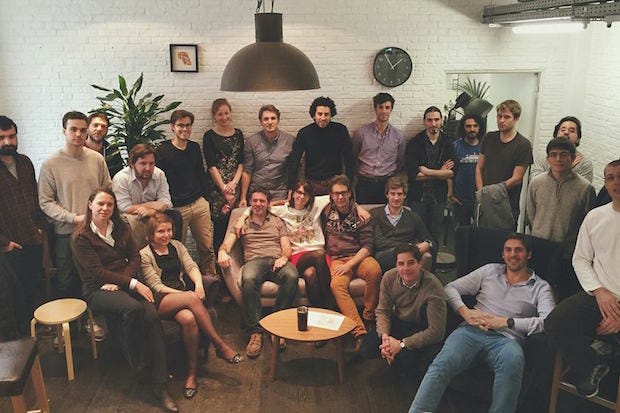
In 2015, Jordane Giuly was wandering through the aisles of B2B Rocks, a SaaS-focused conference held every year in Paris. He did not have much of a network, nor a clear idea in mind, but he was eager to embark on a new entrepreneurial adventure—his two previous attempts had not been great successes. Passing by one of the stages, he heard Didier Forest, then a Design Partner at eFounders, recount the successes of Mailjet and Mention within the startup studio, and explain how to build a “cool” B2B SaaS product.
Intrigued by what he heard, Jordane went to LinkedIn to learn more about eFounders and came across the profile of Thibaud Elzière, with whom he shared a few connections—and, at the time, you didn’t have two hundred mutual contacts on LinkedIn with someone you had never heard of. An introduction and a few messages later, Jordane found himself in eFounders’ offices, on rue Ambroise Thomas in Paris, for an initial conversation with Thibaud.
Brimming with ideas as ever, Thibaud presented Jordane with a project centered on virtual corporate cards to manage company spending. It was an idea a team was already working on. Jordane was immediately enthusiastic and, enjoying coding himself, put himself forward as a potential Chief Product Officer. A few days later, he met Rodolphe Ardant and Guilhem Bellion, the project’s founders, and went through technical interviews with Amaury Sepulchre, the studio’s COO, and Axel Le Pennec, Product Manager and Partner. He was accepted.
At the time, there were two ways to join eFounders. The first was to come in at the ideation stage and work alongside the studio’s Partners to shape the vision. The second was to join a project as a late founder, once the vision had already been drafted and execution was the priority. Jordane belonged to this second wave.
Every week, the founding team of Spendesk had two one-hour meetings with Thibaud Elzière, Quentin Nickmans, and Amaury Sepulchre. The first focused on go-to-market strategy: how to secure the first 50 customers, then the next 100, and so on. The second was devoted to the product, a meeting Jordane was particularly invested in given his role as CPO.
Seated apart, in the back room of the office, everyone sat on couches facing a large screen projecting product mockups. Spendesk was then working on a new feature for multi-entity companies. As Jordane walked through the mock-ups outlining his product vision, he was frequently interrupted by Thibaud, who offered feedback on details that, at first glance, seemed insignificant. It was a reflection of both the level of rigor and the depth of involvement and commitment the studio’s founding team brought to its startups.
“These two recurring meetings force you to work on the fundamentals, especially at the beginning,” Jordane told me. “When you’re at the seed stage, your obsession is figuring out how to land your first 50 customers and what MVP you’re going to ship. Creating accountability around these two core topics means you’re forced to work on them. You don’t want to look like an idiot in those meetings.”
In 2016, there were very few pre-seed funds in Europe, and the investment made by eFounders acted as a powerful accelerator for the studio’s young startups—enough to justify the large equity stake eFounders took at the time, a decision none of the founders I spoke to regretted. But the value eFounders brought did not stop there. From day one, each startup benefited from a cheat code: its network.
Despite the early French tech success stories of the mid-2010s, BlaBlaCar and Veepee among others, the tech ecosystem had not yet fully caught its stride. Hiring was difficult. Talking to journalists was difficult. Raising capital was difficult. The eFounders brand made all of this easier—and still does. Entrepreneurs orbiting the studio were also potential beta testers for the products eFounders was building, and even potential investors.
When Spendesk began its seed round—its first raise after eFounders—many venture capital firms shut the door. The decision was therefore made to start with a round led by business angels. Thibaud and Quentin personally reached out to their network to present the opportunity. Three weeks later, 50 business angels were interested in investing. In January 2017, the fintech raised €2 million.
Today, Jordane is the co-founder and CEO of Defacto, and that same network—journalists, investors, entrepreneurs across the ecosystem—continues to work in his favor. Defacto raised a pre-seed round from GFC and Headline, alongside around 20 business angels, including Thibaud Elzière, and has made the front page of TechCrunch on several occasions.

*
In 2018, the startup studio crossed a symbolic threshold: €100 million raised by six of its startups—Spendesk, Aircall, Forest, Front, Slite, and Station. These funding rounds were led by venture capital firms with global reputations, such as Index Ventures, Accel, and Sequoia Capital.
As the net asset value of the studio’s holdings increased, eFounders made use of financial instruments that allowed it to bridge periods of cash flow and smooth its treasury without diluting its capital. This was a kind of temporary liquidity pump, designed to buy time ahead of larger realizations, which came that very year when TextMaster was acquired.
Buoyed by its success and a growing reputation across the continent, the startup studio began receiving an increasing number of applications from people eager to join eFounders’ core team, responsible for supporting startup launches within the studio. Legal, design, product, engineering, marketing, communications, finance, every profile had a role to play in accompanying the young companies, and around a dozen people joined the studio.
Applications from talented entrepreneurs multiplied as well. Everyone wanted a chance to be launched within the eFounders cocoon. But very few were chosen.
*
In 2018, Alexandre Louisy was attending a dinner hosted by The Family. He was part of one of the Paris accelerator’s cohorts and was working on a startup project aimed at transforming how small and mid-sized businesses were financed. Alexandre was not particularly familiar with the tech ecosystem and did not know how to code. His background was more financial than technical, and he was actively looking for a CTO.
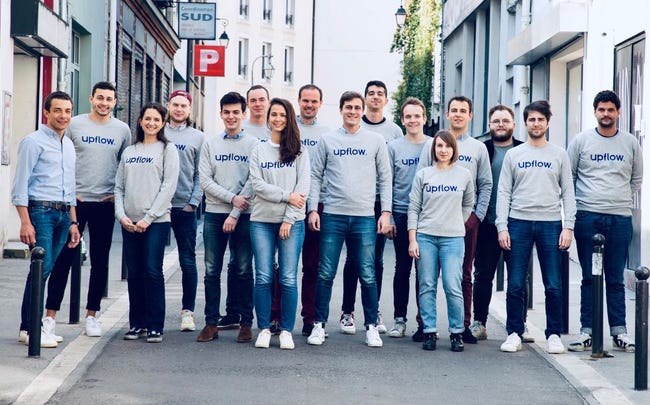
That evening, Alexandre noticed, from across the room, a man in his sixties—an arresting contrast amid the crowd of young tech entrepreneurs, baseball caps pulled low and white sneakers on their feet. After ten minutes spent discussing books and 13th-century illuminated manuscripts, the man was soon joined by his son, who turned out to be… Thibaud Elzière. Fate, it seemed, had a sense of timing. Alexandre shared his project, and the two agreed to continue the conversation over coffee the following week. eFounders was already thinking through a problem related to cash collection, and after two months of challenging one another on the vision, Upflow—initially called InvoiceX—was born within eFounders, with a new mantra: before financing a business, it needs to be paid properly.
By the time Upflow joined eFounders, Spendesk had just left the premises following a record Series B, and the studio’s first companies, such as Front, were accelerating in the United States—a path Upflow would take in 2020. Lunches surrounded by other entrepreneurs became a source of inspiration and motivation for Alexandre. More importantly, they proved to be a powerful lever for getting the startup off the ground.
“At the time, I didn’t have a cofounder, no money, not much of anything,” Alexandre told me. “eFounders gave me a kind of cocoon, a structure that lets you put all the right ingredients in place to start fast and strong. It allowed me to move ten times faster at launch. I met my cofounder through them, and he didn’t come for me; he came for eFounders. It’s the same with our first employee, who’s still with us today. He didn’t join Alex from Upflow; he joined because it was an eFounders company.”
That year, eFounders had reduced its equity stake in startups to 30% post-seed—a move that made room for larger investors, particularly from the United States—and offered founders a first salary, office space, and a dedicated team. Alexandre never regretted the decision, even though Upflow’s time at eFounders lasted just six months, as the startup raised funding unusually fast. That is how it works. After the first funding round, the startup has to leave the nest and take flight. That year, everything happened far faster than expected. Alexandre had never raised a single euro in his life. Thanks to eFounders and its network of business angels, he raised a €2.5 million seed round in just three hours.
Among the lasting habits Alexandre carried over from his time at eFounders was the cadence of product meetings. Today, the startup based in Paris and New York runs a product sprint every two weeks, on Fridays, and the sprints are still numbered from the very first one at eFounders. That rhythm, that early insistence on rigor, remains one of Alexandre’s most valuable lessons. In a company’s earliest months, direction can drift in any number of ways, and choosing the wrong one can lead you astray for good, or even prove fatal. Having the eFounders team around him is something Alexandre remains deeply grateful for, even today.
*
In 2019, eFounders surprised its ecosystem by venturing beyond its usual perimeter for the first time. Five years earlier, Quentin and Thibaud had come up with the idea of launching a company in electronic signature, a project that fit squarely within their Future of Work thesis. Yousign, based in Caen, had been founded a year earlier, and the studio’s team met Luc Pallavidino and Antoine Louiset, the founders of the Normandy-based startup, to discuss a potential collaboration. The idea of moving forward together was raised, but proved difficult to execute at the time. It was set aside, though never entirely forgotten.
By 2019, eFounders had generated liquidity through a number of partial exits, notably from Front. These transactions helped simplify complex legacy arrangements, distribute a larger-than-expected dividend to shareholders, and strengthen Hexa’s balance sheet. It was then that the idea of electronic signature resurfaced.
A lunch was organized with the Yousign team. Seeing the company’s potential, and for financial reasons as well, Quentin and Thibaud proposed buying out the startup’s investors, along with the shares of one associate whose path was about to diverge. The goal was not merely to invest, but to adapt the studio’s early-stage playbooks to more mature technology companies in need of renewed momentum. At the time of eFounders’ investment, Yousign was generating €1.8 million in annual revenue. Today, it generates more than €35 million.
This move marked the early signs of a broader reorganization and an ambitious expansion.
*
In 2020, Camille Tyan had left Payplug, the payments company he had co-founded, with the ambition of launching his own fintech-focused startup studio. He met with the Hexa team to discuss the idea and proposed that they become investors. Quentin and Thibaud had already experimented with a similar arrangement in the past, and it had not worked, creating conflicts of interest with their own model. A counterproposal was therefore made to Camille: to create his startup studio within eFounders. He would choose and run his own projects, benefit from the studio’s infrastructure, and share equity with eFounders and the founders of each venture. Logic Founders, eFounders’ fintech startup studio, was born.
The principle behind Logic Founders mirrored that of eFounders. Camille had encountered numerous challenges in payments during his time at Payplug and saw this studio as the ideal opportunity to address them—a kind of laboratory for experimenting with the future of finance. “I needed a system to connect to SEPA payments for transfers and direct debits, and we had built that ourselves, which was extremely complex. So, I created Numeral with Edouard and Hichem. The second was that we had developed a transaction scoring engine to fight fraud and money laundering, and that’s why we created Marble with Arnaud and Pascal.”
For every project he embarked on, Camille followed a simple rule, at least on paper: don’t reinvent the wheel. “We’re not inventing something new. We’re fixing something that doesn’t work well in a world of giants generating huge profits. We didn’t invent online card payments with Payplug. There were plenty of financial institutions handling transfers and SEPA direct debits before Numeral, and many ways to fight fraud before Marble. What we’ve always focused on, across these three companies, is customer experience, ease of use, and ease of integration.” Less than four years later, and before Logic Founders closed its doors, Numeral was acquired by Mambu, the Dutch core banking specialist.
For Quentin and Thibaud, the success of this first verticalized studio was a moment of realization. eFounders would no longer be just an “artisanal” studio, but a platform capable of hosting partners and verticals.
A parent entity emerged in 2022: Hexa. After a decade as COO, Amaury Sepulchre joined as a co-founder. The eFounders brand remained dedicated to the Future of Work, while new verticals took shape in Web3 with 3Founders, artificial intelligence with Hexa AI, and healthcare with Hexa Health.
*
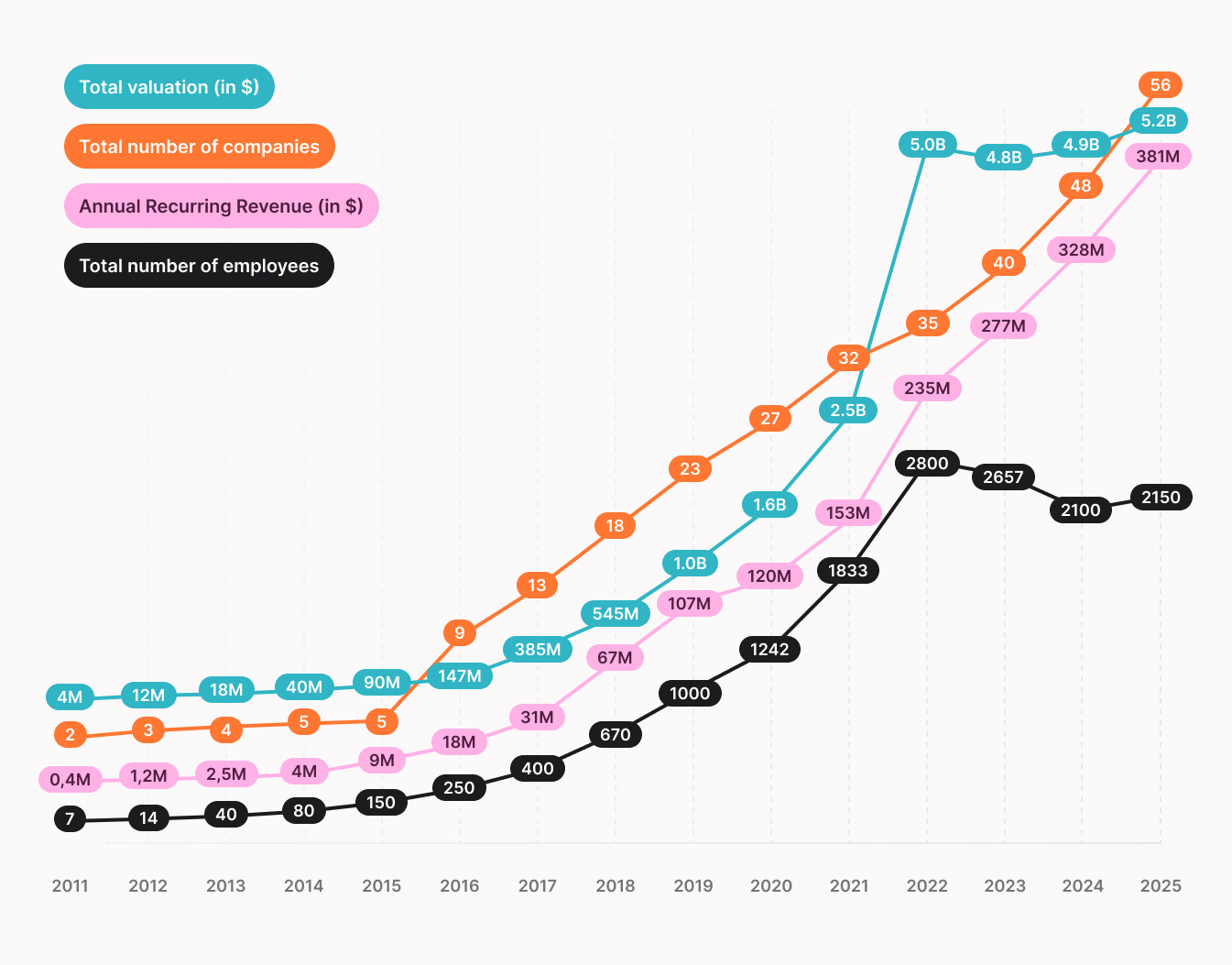
In 2023, Hexa completed a new €20 million funding round. The stated objective was to launch 30 new startups per year by the end of the decade through its Start program. As with its first raise in 2015, the round was backed by entrepreneurs and family offices. On that occasion, Hexa also announced its move into new Paris headquarters: La Cristallerie, located in the lively Strasbourg-Saint-Denis district of Paris’s 10th arrondissement.
That same year, Hexa Scale was launched, an initiative designed to support more mature startups financially, strategically, and operationally. Much like what the startup studio had done with Yousign four years earlier, Hexa takes majority stakes and becomes directly involved in day-to-day operations. The companies typically generate between €2 million and €10 million in ARR, and the goal is to trigger a new phase of growth by rethinking the product, the brand, the GTM and the vision. The program runs for twelve to eighteen months, during which founders may sell part of their equity and a late cofounder will join the leadership team. Exit horizons are shorter within Scale, with a model closer to private equity.
In parallel, Hexa structured its Start activity around a first dedicated fund: Hexa Build 1. The aim is to finance startup launches through an investment vehicle rather than directly from the company’s balance sheet, allowing investments to be pooled. Where Hexa previously committed an average of €800,000 per project on its own, capital is now provided jointly by Hexa, the Build fund, and, when relevant, additional co-investors. This structure enables Hexa to launch more projects while reducing the cash outlay per startup. The equity stake taken in startups was again reduced in 2025 to 25% post-seed.
The most recent program launched by the studio is Hexa Sprint, introduced a few months ago—a Hexa-style accelerator with a vertical focus. Each partner is responsible for one vertical and oversees the acceleration of ten to twelve companies per year. €500,000 is invested for a 10% equity stake. Just as eFounders differed from Rocket Internet, Sprint differs from Y Combinator with a longer support period of six to nine months, and deeply verticalized expertise.
To support this transformation, Matthieu Gombeaud was appointed CEO of Hexa in September 2025. That same year, five companies were launched within Hexa’s historical Start activity, two within Hexa Scale, its micro private-equity arm, and three within Hexa Sprint. A three-month immersion in the Bay Area is also offered as part of the Start program, allowing founders to confront the most dynamic tech ecosystem in the world.
*
Liquidity has always been a central issue in the life of the startup studio—and, more broadly, in the venture-capital model itself. For Hexa, it is not a peripheral financial concern, but a condition of prosperity. The studio ties up capital, teams, and energy for many years, often with no short-term prospect of returns. And yet, the economic context has changed profoundly.
The companies built today are more ambitious, more complex, and far more capital-intensive. Where an initial public offering once occurred around €100 million in revenue, the threshold is now well above €500 million. In 2025, when Klarna went public, the fintech founded in 2005 was generating more than two billion dollars in revenue. Decade-old companies like Stripe or Revolut, whose revenues have surpassed one billion dollars, have still not taken that step.
Exit horizons have lengthened. Profitability requirements have intensified, sometimes at the expense of growth. Capital duration is stretching, even as the system has not fully adapted to this new time frame. “Duration is too long,” Quentin Nickmans told me. “Between the moment funds raise capital, commit it, and the time it takes to create value, we end up with 15-year cycles. It’s a DPI crisis for early-stage investing. This increase in duration should force liquidity onto the cap table. I sit on the boards of many companies, and we simply don’t talk about it.”
Hexa’s reorganization into a platform, the creation of new investment vehicles, and the broader thinking led by Quentin all stem from this logic: making liquidity a normal, structural, and recurring mechanism. Not the end of the entrepreneurial journey, but its fuel. The condition that makes it possible to endure, to start again, and to keep financing entrepreneurs over the long term.
Main sources and references:
I would first like to thank Quentin Nickmans, Sarah Barron, Alexandre Louisy, and Jordane Giuly for the time they generously gave me. Our conversations form the backbone of this piece. Reconstructing Hexa’s story was also made easier thanks to Thibaud Elzière’s Medium, the startup studio’s own blog, and the podcasts Billions and Donne le Rythme. Finally, for broader context on the state of venture capital and liquidity challenges, I recommend the State of European Tech report and Quentin’s Substack, Liquid.
Most entrepreneurs sell what they build, but the best ones sell what it means. Access my one-page memo to learn why and how to craft your story.
TY
Thanks so much for the great piece, Thomas :)
Amazing story!